
Diwali is the perfect time to refresh your home, welcome guests and create a warm,…
Revamp Your Home This Festive Season: Why Natural Stone is the Ultimate Choice for Diwali Renovations
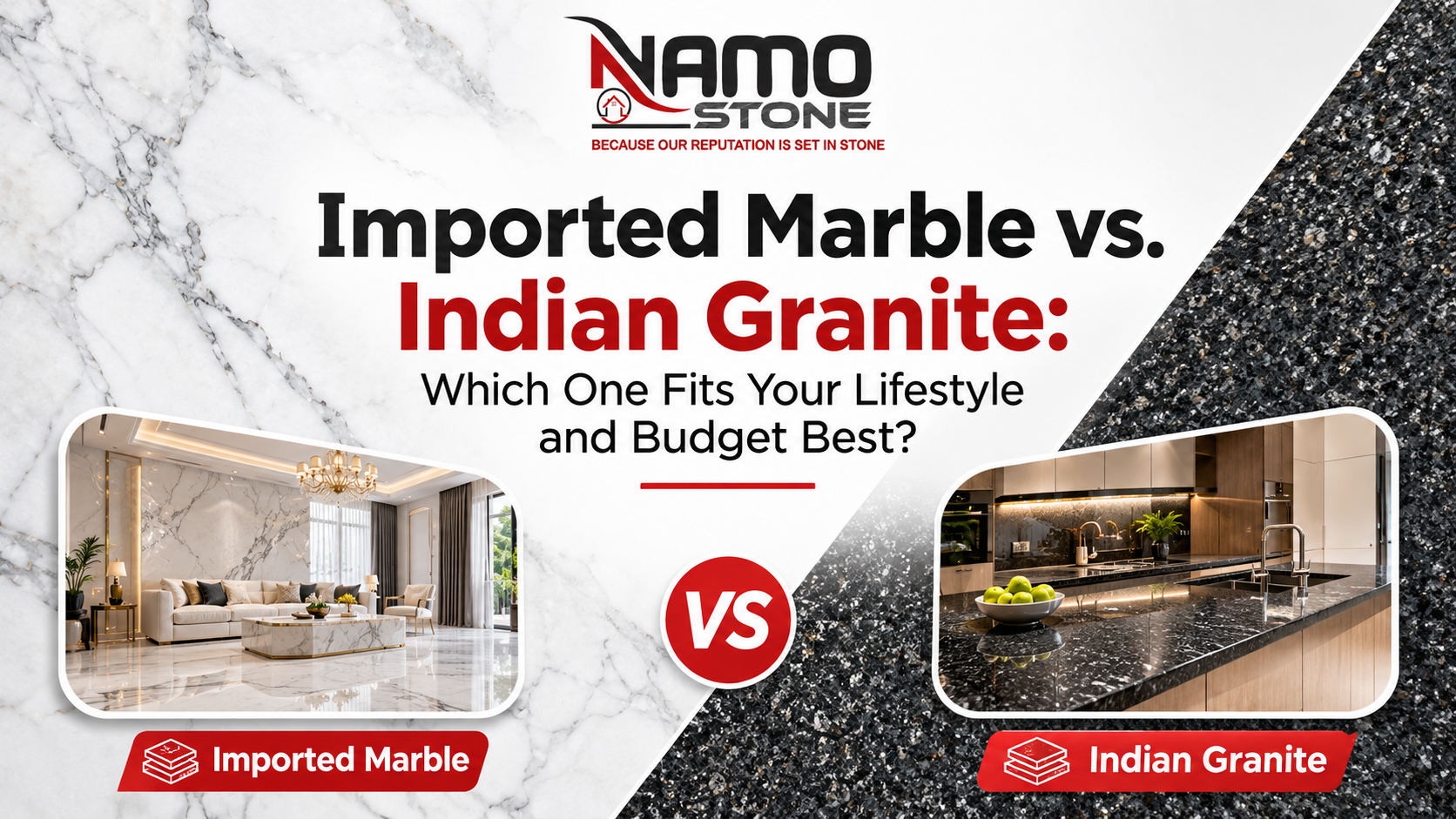
Choosing between imported marble and Indian granite is an important decision when building or renovating a home. The right natural stone can transform your interiors, improve everyday functionality, and influence your property’s long-term maintenance costs. However, both materials offer different advantages in terms of appearance, durability, pricing, and applications. Imported marble is popular for its luxurious appearance, elegant veining, and premium finishes. Indian granite, on the other hand, is valued for its hardness, durability, versatility, and practical performance. So, which is better for your home? Should you invest in imported marble for sophisticated interiors, or choose Indian granite for everyday functionality? In this guide, Namo Stone compares imported marble vs. Indian granite across all important factors, including cost, quality, maintenance, durability, applications, and Indian weather conditions, helping you make the right decision for your lifestyle and budget.
Quick Answer: Imported Marble vs. Indian Granite
Imported marble is generally better suited to luxury interiors, statement flooring, and decorative walls, while Indian granite is generally a more practical option for kitchen countertops, staircases, high-traffic flooring, and outdoor applications. If appearance and distinctive natural patterns are your priority, consider imported marble. If durability, scratch resistance, and everyday maintenance matter more, Indian granite is worth considering.
1. What Is Imported Marble?
Imported marble is natural stone sourced from international markets, including Italy, Turkey, Greece, Spain, Egypt, Vietnam, and other countries. It is widely used in premium homes, luxury hotels, commercial interiors, and architectural projects. Its distinctive veining, natural colour variations, and elegant surface finishes make it a popular choice for homeowners looking to create sophisticated interiors.
Popular Imported Marble Varieties
- Statuario Marble: Recognised for its white background and dramatic grey veins.
- Calacatta Marble: Known for bold natural patterns and a luxurious appearance.
- Carrara Marble: Features subtle grey veining against a soft white background.
- Dark Emperador Marble: Offers rich brown shades with lighter natural patterns.
- Port Laurent: A striking dark stone featuring golden and white veins.
- Ottoman Beige: A warm-toned variety suitable for elegant interior designs.
Where Is Imported Marble Used?
Imported marble is commonly selected for living room flooring, bedroom interiors, feature walls, hotel lobbies, reception areas, decorative staircases, and premium architectural projects.
2. What Is Indian Granite?
Indian granite is a natural igneous stone formed through the slow cooling of molten magma beneath the Earth’s surface. Its mineral composition gives it excellent hardness and makes it suitable for areas requiring durable surfaces. India offers a diverse selection of granite varieties in different colours, patterns, textures, and finishes.
Popular Indian Granite Varieties
- Black Granite: A timeless option for kitchen countertops and commercial flooring.
- Alaska White Granite: Features a light background with distinctive mineral patterns.
- Alaska Gold Granite: Combines golden, grey, white, and brown tones.
- White Granite: Suitable for bright and contemporary interiors.
- Red Granite: Adds a bold appearance to traditional and modern spaces.
- Brown Granite: Complements warm interiors and wooden furniture.
- Grey Granite: A versatile choice for modern architectural projects.
Indian granite is widely used for kitchen countertops, flooring, staircases, entrances, commercial spaces, and selected outdoor applications.
3. Imported Marble vs. Indian Granite: Complete Comparison
| Comparison Factor | Imported Marble | Indian Granite |
| Appearance | Elegant and luxurious | Natural and versatile |
| Patterns | Flowing natural veins | Granular mineral patterns |
| Hardness | Generally softer | Generally harder |
| Scratch Resistance | More susceptible to scratches | Generally higher |
| Stain Resistance | Requires careful maintenance | Generally better when sealed appropriately |
| Acid Resistance | Sensitive to acidic substances | Generally more resistant |
| Heat Resistance | Suitable for many interior uses | Generally excellent |
| Maintenance | Requires more careful attention | Relatively easy |
| Price | Premium varieties can be expensive | Wider range of budget options |
| Best Use | Luxury interiors and feature walls | Kitchens, flooring and staircases |
Important: Actual performance varies according to the individual stone, porosity, finish, treatment, and installation quality.
4. Which Is More Durable: Imported Marble or Indian Granite?
Durability is one of the most important considerations when selecting natural stone. Imported marble provides an elegant surface and can last for many years with suitable installation and maintenance. However, it is generally softer than granite and more susceptible to scratches and acid etching. Granite is generally harder and more resistant to everyday scratching. This makes it suitable for frequently used surfaces and high-traffic areas. Winner for everyday durability: Indian granite.
5. Which Is More Affordable? Imported Marble vs. Indian Granite Price
The price of natural stone depends on its variety, quality, thickness, dimensions, finish, availability, transportation, and processing requirements.
Imported Marble Cost
Premium imported marble varieties, including Statuario and Calacatta, generally require a higher investment because of their distinctive patterns, origin, availability, and transportation requirements.
Indian Granite Cost
Indian granite is available across several price categories, making it suitable for different residential and commercial budgets. Namo Stone’s website advertises starting factory prices of ₹65 per sq. ft. for Indian granite. Actual quotations depend on the selected variety, specifications, quantity, and finish.
Additional Expenses to Consider
- Material purchase price.
- Transportation and delivery.
- Cutting and edge profiling.
- Installation and labour.
- Surface polishing and finishing.
- Material wastage.
- Sealing and future maintenance.
Budget verdict: Indian granite generally provides a practical balance of price and durability, while premium imported marble is an investment in distinctive interior aesthetics.
6. Maintenance: Which Stone Is Easier to Clean?
Imported marble requires careful maintenance because acidic substances such as lemon juice and vinegar can damage its surface finish.
For better maintenance:
- Use pH-neutral stone cleaners.
- Avoid acidic household cleaning products.
- Clean spills promptly.
- Use suitable sealers when recommended.
- Arrange professional polishing when necessary.
Indian granite is generally easier to maintain. Regular cleaning with water and a suitable mild cleaner helps preserve its appearance. Sealing requirements depend on the individual variety and its porosity.
Maintenance verdict: Indian granite is generally more convenient for busy households.
7. Which Stone Is Best for Different Areas of Your Home?
Living Room: Imported marble is an excellent option for elegant flooring and statement interiors.
Kitchen: Indian granite is generally preferred for countertops because of its hardness, scratch resistance, and heat resistance.
Bedroom: White, beige, and grey imported marble varieties can create sophisticated bedroom interiors.
Staircase: Indian granite is a popular choice because of its resistance to everyday wear. Select an appropriate finish for slip resistance.
Bathroom: Both materials can be used, provided suitable finishes, waterproofing, sealing, and installation methods are selected.
Outdoor Spaces: Indian granite with an appropriate textured finish can be suitable for entrances, pathways, and steps. Check weather suitability before purchasing.
8. Which Stone Is Better for Indian Weather Conditions?
India experiences diverse climatic conditions, from the hot and dry summers of Rajasthan to humid coastal regions and heavy monsoon rainfall. In Rajasthan, both imported marble and Indian granite can be suitable for indoor applications. Marble is often selected for its elegant appearance and comfortable underfoot feel, while granite offers greater resistance to everyday wear. For humid environments, moisture management, suitable stone selection, and professional installation are important. For outdoor applications, consider the stone’s water absorption, weather suitability, surface texture, and slip resistance.
9. What Should You Check Before Buying Marble or Granite?
Before purchasing natural stone, inspect the actual slabs and consider these factors:
- Slab Quality: Check for visible cracks, unwanted fissures, and surface imperfections.
- Colour Consistency: Compare the complete slab or selected lot.
- Thickness: Confirm that it meets your application requirements.
- Surface Finish: Compare polished, honed, leathered, and textured finishes.
- Stone Origin: Ask for reliable sourcing information and documentation where applicable.
- Maintenance: Understand cleaning and sealing requirements.
- Installation: Confirm cutting, fitting, and edge-finishing arrangements.
- Quotation: Request a complete cost breakdown.
- Quantity: Include appropriate allowances for project-specific cutting and wastage.
Visiting a natural stone showroom is a useful way to compare actual colours, patterns, and finishes before making your selection.
10. Why Choose Namo Stone for Imported Marble and Indian Granite?
Selecting the right supplier is just as important as choosing the right stone. Namo Stone India, located in Kishangarh, Rajasthan, offers imported marble, Indian marble, and Indian granite for residential, commercial, and architectural projects. Its collection includes premium white, beige, grey, and highlighter marble varieties, along with different granite options.
What Makes Namo Stone Worth Considering?
- Wide Product Selection: Explore imported marble, Indian marble, and Indian granite varieties.
- International Sourcing: Imported stone options from markets including Italy, Turkey, Greece, Spain, China, Vietnam, Egypt, Namibia, Iran, and Afghanistan.
- Processing Facilities: Robotic processing, cutting, polishing, and finishing facilities.
- Customisation: Explore customised cutting, edge profiling, and surface treatments.
- Multiple Applications: Materials for flooring, countertops, walls, staircases, and architectural projects.
- Showroom Selection: Inspect natural stone patterns and finishes before purchasing.
- Project Support: Options for homeowners, architects, builders, contractors, and commercial projects.
11. Final Verdict: Imported Marble or Indian Granite?
There is no universal winner in the imported marble vs. Indian granite comparison. Both materials serve different purposes.
Choose imported marble if you want:-
- Premium and luxurious interiors.
- Distinctive natural veining.
- Elegant flooring and decorative walls.
- A sophisticated architectural appearance.
Choose Indian granite if you need:-
- Greater everyday scratch resistance.
- Practical kitchen countertops.
- Durable flooring and staircases.
- Relatively easy maintenance.
- Natural stone options across different budgets.
Our recommendation: Combine both materials strategically. Use imported marble for statement interiors and Indian granite for frequently used surfaces. This approach can help balance design, functionality, and project costs. Explore the natural stone collection at Namo Stone and find a suitable option for your next residential or commercial project.
Contact Namo Stone India
Address: Near Marble City Hospital, RIICO Industrial Area, Kishangarh, Rajasthan 305801
Phone: +91 80030 65575
Email: contact@namostone.com
Website: https://namostone.com/
Frequently Asked Questions
Imported marble is generally better for luxury aesthetics and distinctive natural patterns, whereas Indian granite is generally better for durability and everyday applications.
Granite is generally harder and more scratch-resistant than marble, making it a practical choice for high-traffic areas.
Indian granite generally offers more budget-friendly options. Premium imported marble varieties can cost significantly more depending on origin, quality, and availability.
Indian granite is generally a practical choice because of its hardness, scratch resistance, and heat resistance.
Yes. Imported marble requires suitable cleaning products, prompt spill removal, and periodic maintenance depending on its variety and finish.
Yes. Imported marble is widely used for living rooms, bedrooms, hotels, and premium residential flooring.
Alaska White, Alaska Gold, black granite, white granite, grey granite, and brown granite are popular options.
Yes. Imported marble can be used for decorative flooring and feature walls, while granite can be selected for kitchen countertops, staircases, and frequently used spaces.

Related Posts


This Post Has 0 Comments